
Technical security and intruder alarm systems

Technical building security and integrated security systems

Amplituda designs and integrates technical security systems that can bring together video surveillance, intruder alarms, access control and IP door intercoms. Security functions do not have to be separate from the rest of the building: depending on the design, they can exchange information with lighting, blinds, heating or visualisation. Relevant statuses and notifications can be shown to the user, and certain events can trigger predefined responses.

Leaving, arriving and alarm scenarios can combine several actions, and suitable equipment can send e-mail and push notifications. Integration is always adapted to the specific equipment and the security concept of the building. The goal is a clear system in which every security component has a defined role and works reliably with the others.

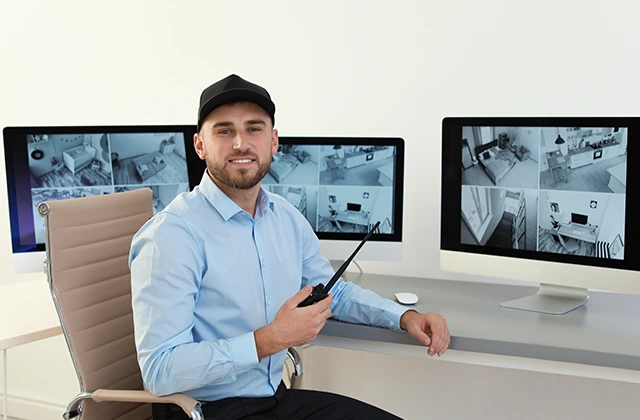
Operator monitoring CCTV on multiple screens – technical security system

Security that can respond actively

Video surveillance and an alarm system do not have to serve only for reviewing events after the fact. Depending on the capabilities of the installed equipment, a particular event can trigger a notification or a linked function: switching on the lights, activating a siren, changing the position of the blinds or displaying information in the user interface.

Where the chosen equipment supports it, modern cameras and security systems can send a message or push notification with an image when a suspicious situation is detected. Such functions should be defined carefully so that responses are useful and predictable, without unnecessary alarms. Integration is an additional layer that links security equipment, but it does not replace a properly designed core security system.
Leaving and arriving scenarios

One advantage of integration is the ability to combine several actions into a logical scenario. When leaving the building, the alarm can be armed, unnecessary lighting switched off, selected blinds lowered and the temperature mode changed. On returning, after appropriate authorisation, welcome lighting and other agreed functions can be activated.

In an alarm situation, the system can carry out a different set of responses, for example switching on indoor and outdoor lighting or sending a notification. The specific functions depend on the project, but the principle is always the same: the user does not have to carry out a series of separate actions manually when the systems can respond to a known situation in a coordinated way.

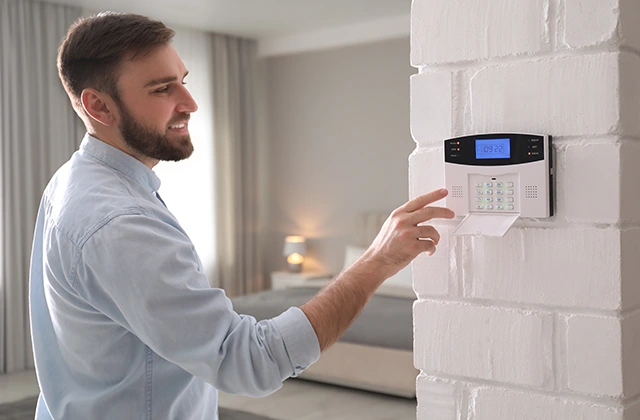
User arming the alarm system on a wall keypad when leaving
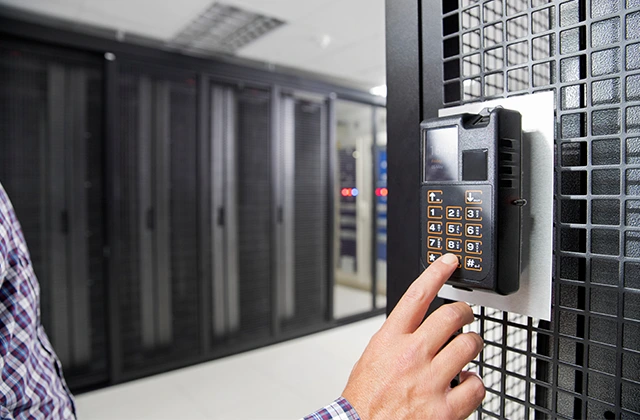
Access control with card reader and keypad at the entrance

Video surveillance and access control

Video surveillance provides a visual overview of the key areas of a building, while access control and IP door intercoms manage who enters the space and how. In an integrated system, the user can get relevant information about a call at the entrance, the status of selected access points or the cameras in one place, depending on the chosen equipment.

This approach is particularly practical in residences, commercial buildings and buildings with several entrances. The network infrastructure must be properly designed, because much of today’s security equipment relies on IP communication. That is why technical security should be planned together with the LAN, power supply and service access.

Monitoring without a multitude of interfaces

When technical security becomes part of a wider visualisation, the user does not have to open a separate system for each function. Relevant alarm statuses, cameras, the door intercom or selected controls can be displayed in a clear interface on a touch panel, tablet or mobile device, depending on the project. The aim is not to show as much data as possible, but only the information that helps the user quickly understand the state of the building and respond.

Remote access should be organised thoughtfully and securely. Well-designed integration combines convenience and clarity while keeping a clear boundary between user control, security logic and the system’s service functions.

Monitoring centre with CCTV and security system screens

A security system is most valuable when it provides useful information in good time and triggers an agreed response, not just when it records an event. Integrating technical security reduces the number of separate controls and links security functions with the logic of the whole building.